The Young Shepherd Boy

Three thousand years ago, in the rolling green hills of the Judean Mountains, there lived a young shepherd boy. He was the youngest of seven brothers, and every day he roamed the hills, tending to the family’s sheep, traveling with them wherever they went and never left them alone.
Like many boys his age, he spent time practicing the sling to ward off wolves or danger and to have a bit of fun. But he was a sensitive boy who spent time worshipping his God, the God of Israel, by playing the harp and singing. His voice was soft and pleasing to many, and he wrote songs and poetry dedicated to Adonai, his God. Sometimes, he would play his harp and sing to people in his community, and they were soothed and calmed by his music. At other times, he would play his harp alone, with only the sheep to keep him company.
A Special Heritage
From early childhood, his mother and father might have reminded him of his special lineage — his great-grandfather, Boaz, redeemed a young woman named Ruth, whose first husband had died. She had no children, husband, or way to earn a living except by gathering leftover wheat in the fields. But Boaz was so deeply moved by her kindness and compassion to her mother-in-law, Naomi, that he decided to redeem her by marrying her.
When their son, Obed, was born, they likely shared with him that his life was only possible through the redeeming act of Boaz — and that to live up to his father’s name, he, too, was to be a redeemer for his people: a man of kindness, compassion, and grace to others.
The young shepherd boy named David may have been told the same. His life was to be dedicated to redeeming his fellow man. He should live a life worth honoring the name of his great-grandfather.
The Prophet Samuel Visits the Family of Jesse
When David was as young as 14, an old man came to his father’s house. The old man was Samuel, a prophet who was well-known for his miraculous abilities to prophesy future events and even call down thunder and rain upon the land. Everyone knew of him, and everyone held him in high esteem.
When he came to visit David’s family, he told David’s father, Jesse, to present his sons to him so that one of them might be anointed and chosen as the next king of Israel.
So there, in the rolling green hills of the Judean Mountains, the seven sons of Jesse lined up, one after the other. They watched the old prophet as he looked upon them. Their eyes glistened with great excitement as they contemplated being chosen. One word from this prophet and their lives would be forever transformed.
“The Lord Looks on the Heart”
When Samuel looked upon Eliab, one of Jesse’s sons, he thought to himself, “Surely, this is the one I will anoint.” But the Lord spoke to him, making him aware of this important reality:
“Do not look on his appearance or on the height of his stature, because I have rejected him. For the Lord sees not as man sees: man looks on the outward appearance, but the Lord looks on the heart.” —1 Samuel 16:6-7 ESV
One by one, Samuel looked into the eyes of each of Jesse’s sons, and one by one, Samuel passed them by until all seven of the boys had been passed over. You can imagine the sorrow they must have felt as he passed each of them by.
Finally, Samuel asked Jesse, “Do you have any more sons?”
Samuel Anoints David
David was alone with the sheep, as he always was, unaware any of this was happening. Then, his brothers were tasked with going to find him. You can imagine the sorrow in their voices as they told David to come with them.
When David arrived in front of Samuel, God spoke to Samuel. “Arise, anoint him, for this is he.” And there, as the wind passed over the hills, Samuel poured out the olive oil in his flask. The oil ran down the head of David and dripped down his clothes. The Spirit of God, of Adonai, came upon the boy. He could feel something stirring in his chest, in his hands, in his feet, and even in his mind. His brothers and his father all watched in amazement. This was God’s chosen, anointed, and favored son — not just in the house of Jesse but in all of Israel.
And then, the prophet Samuel left. He likely told the boy and his father to keep it quiet lest the current king find out and have him killed. David, after being anointed future king, went back to tending his sheep. There was no great uprising of the people to place the young shepherd boy on the throne — life carried on precisely as before.
The Boy Becomes King
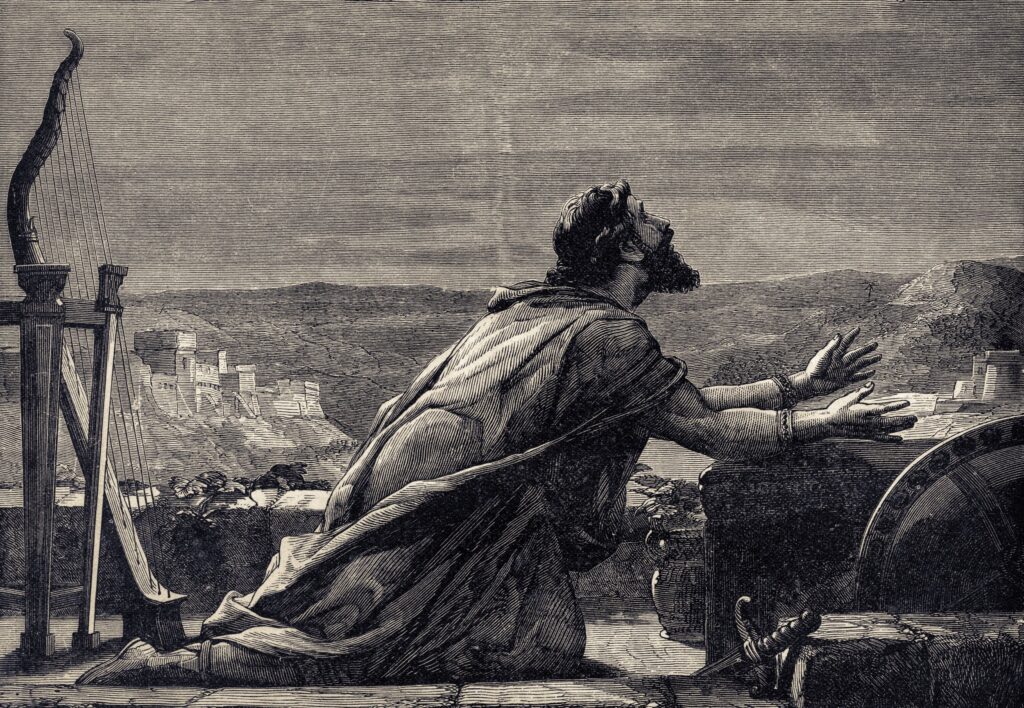
It took 15 long years for David to ascend the throne of Israel and become the king. In that time, he fought several battles and killed many men. He lived as an outlaw and fugitive from his own people and married several women. He was no longer the young, innocent shepherd boy he once was. He was hardened by war, betrayal, and the death of his closest friend.
When he finally sat on the throne, a prophet named Nathan came to him with a promise from God. This promise announced a blessing upon David and his family. It was perhaps the most powerful and monumental blessing in all scripture.
“Now then, tell my servant David, ‘This is what the Lord Almighty says: I took you from the pasture, from tending the flock, and appointed you ruler over my people Israel. I have been with you wherever you have gone, and I have cut off all your enemies from before you. Now I will make your name great, like the names of the greatest men on earth. And I will provide a place for my people Israel and will plant them so that they can have a home of their own and no longer be disturbed. Wicked people will not oppress them anymore, as they did at the beginning and have done ever since the time I appointed leaders over my people Israel. I will also give you rest from all your enemies.” —2 Samuel 7:8-11 NIV
An Incredible Blessing!
This was an incredible blessing over David. It was very similar to the blessing God gave his forefather, Abraham. But then, in this moment, God did something new. God did something unprecedented in all of human history.
“‘The Lord declares to you that the Lord himself will establish a house for you: When your days are over and you rest with your ancestors, I will raise up your offspring to succeed you, your own flesh and blood, and I will establish his kingdom. He is the one who will build a house for my Name, and I will establish the throne of his kingdom forever. I will be his father, and he will be my son. When he does wrong, I will punish him with a rod wielded by men, with floggings inflicted by human hands. But my love will never be taken away from him, as I took it away from Saul, whom I removed from before you. Your house and your kingdom will endure forever before me; your throne will be established forever.’” —2 Samuel 7:11-16 NIV
Can you imagine hearing this? Can you imagine God speaking a prophetic blessing over David, promising to raise up offspring to become future kings? And not only that — but promising to never take his love away from him, and to establish his kingdom forever.
“Who am I? What is my family?”
David was so overwhelmed by this moment that he sat down and worshipped God. “Who am I, Sovereign Lord, and what is my family, that you have brought me this far?”
There must have been great excitement throughout Israel when this blessing was spoken. David’s eldest son, Amnon, would be the next great King of Israel! But then, in just a few short years, Amnon was assassinated by Absalom. Eventually, David’s son Solomon became king!
For several years, Solomon was a wise and great king. His latter years, however, were marked by idolatry and faithlessness. After Solomon’s death, the kingdom of Israel started to fall apart. And 500 years later, the kingdom of David and Solomon perished from the earth, apparently never to rise again.
The Blessing Forgotten
What would you think of the blessing announced by God over David if you lived during this era? How could it be that a descendant of David would reign as a king when the kingdom was long gone? Perhaps people thought this blessing was not from God but from an overly excited prophet who was pleased to see David on the throne. Perhaps God had not truly spoken, or if He had, maybe God had forgotten Israel and his promises.
But 1,000 years after this promise of God, when all hope for a Davidic king to sit on the throne had long faded from memory, an angel of God appeared to a descendant of David — a young girl, only 16 years of age — a girl named Mary:
“The angel said to her, ‘Don’t be afraid, Mary; God has shown you his grace. Listen! You will become pregnant and give birth to a son, and you will name him Jesus. He will be great and will be called the Son of the Most High. The Lord God will give him the throne of King David, his ancestor. He will rule over the people of Jacob forever, and his kingdom will never end.’” —Luke 1:30-33 NIV
“The Lord will give Him the throne of King David!”
When Israel rejected God as their king and demanded a human king to be like the other nations, God was displeased and angry. So when David became king, God made a promise to raise up a king who would establish a kingdom forever and whose character would never cause His love and favor to departd. But a human king could never do this, not even David himself.
In fact, shortly after this promise, David conspired to kill a man and take his wife for himself. Solomon, in his old age, turned from the Lord and worshipped idols. So, God sent himself in the form of a child. It was as if God was saying, “If you will not accept me as a heavenly King, I will come down from the heavens and be your earthly King.”
The Last Supper
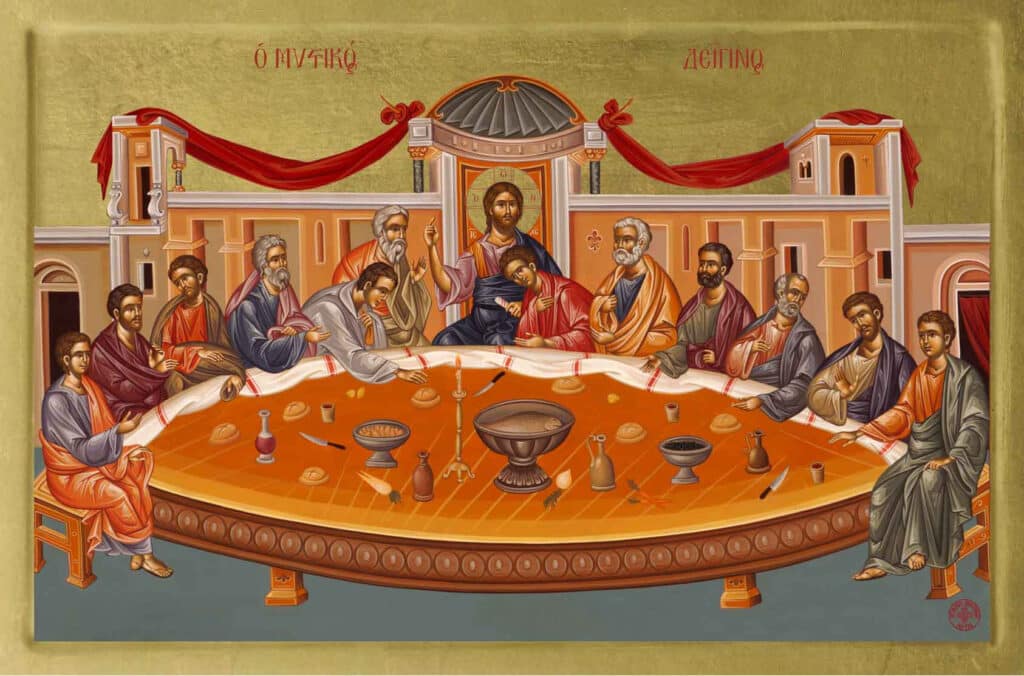
In John 6:53-56 Jesus astounded the crowds when he said, “…unless you eat the flesh of the Son of Man and drink His blood, you have no life in you. Whoever eats my flesh and drinks my blood has eternal life…” According to John, upon hearing this, many of his disciples said, “This is a hard teaching…” (John 6:60). Later, according to Verse 66, “many of His disciples turned back and no longer followed Him.”
The night Jesus was betrayed, as His disciples gathered around the Passover table, Jesus took bread and broke it, saying, “This is my body given for you” (Luke 22:19. After the supper, he took the cup, saying, “This is the new covenant in my blood, which is poured out for you” (Luke 22:20). With these words Jesus transformed Passover into the Lord’s Supper and Holy Communion.
All of this must have been confusing and perhaps even horrifying to the disciples. Why would they need to eat his flesh and drink his blood (John 6)? Why would they need to eat bread that represented His body or drink wine that represented His blood (Luke 22)?
Because these elements represented the work He was about to accomplish on their behalf through His suffering and His death. The blood of God (Acts 20:28) mixed with the blood of a shepherd boy (Matthew 1:1-17) would be poured out, making it possible for ordinary people like you and me to be cleansed, forgiven, justified, and adopted into the family of God and thereby become heirs of God and co-heirs with Jesus (Romans 5:1-2; 8:17).
The Promise Fulfilled.
The promise God had given to David hundreds of years before would be fulfilled through Jesus, as through His death, burial, resurrection, and ascension, He became the descendant of David who would establish a kingdom that would last forever (Acts 15:15-18)!
When we gather for holy communion and drink the wine and eat the bread, we are remembering the sacrifice of Jesus — His beaten and bruised body and His shed blood. We contemplate His willingness to humble Himself, taking upon Himself a robe of flesh, the nature of a servant, and being made in our likeness.
He appeared as a human being and submitted Himself in obedience to God, dying a criminal’s death on the cross — for our sins, in our place. But death would not write the final word in His story. On the third day, He was raised from the dead. God exalted Him to the highest place, giving Him a name above every name (Philippians 2:6-11). The Lamb was actually a Lion. The servant was actually the King (Revelation 5)!
God fulfilled the promise He made to David to “establish his throne forever,” through the birth, life, death, resurrection, and ascension of Jesus, who, in his earthly genealogy, descended from the line of King David (Matthew 1:1-17).
The Goodness of God on Display!
This is the goodness and grace of God on display! Even though David broke God heart through willful sins, including adultery, murder, and pride, God loved him so much that he gave his only begotten son (John 3:16) to bring about His and our redemption.
Even more, through faith in what Jesus has accomplished on the cross, people like you and me become part of the redemptive story God is writing that makes us heirs and co-heirs with Jesus — able to cooperate with Him in His rule and reign!
To the one who is victorious, I will give the right to sit with me on my throne, just as I was victorious and sat down with my Father on his throne.” —Revelation 3:21 NIV
Holy Communion Is A Means of Remembering What Jesus Has Done.
This is all made possible through what Jesus accomplished on the cross. He provided Holy Communion as a means of remembering His finished work and His ability to redeem the broken and fractured stories of people like David and people like you and me (1 Corinthians 11:23-26).
If you’ve enjoyed this perspective on Communion and The Last Supper, check out Matthew Foley’s unique perspective on communion in the ISOW course THIS WE BELIEVE (In English Only) and Lesson 10 on The Doctrine of Holy Communion. You can view this course here: https://isow.org/courses/this-we-believe/
To view courses in Spanish, click here.